
Is Build-Operate-Transfer the Right Model for Opening a Tech Hub in Europe?
Find out whether the BOT model is the best option for setting up a tech hub in Europe. Compare it with other alternatives and discover why Portugal is a strategic location for building your engineering team.
Quick answer
What the BOT model actually is
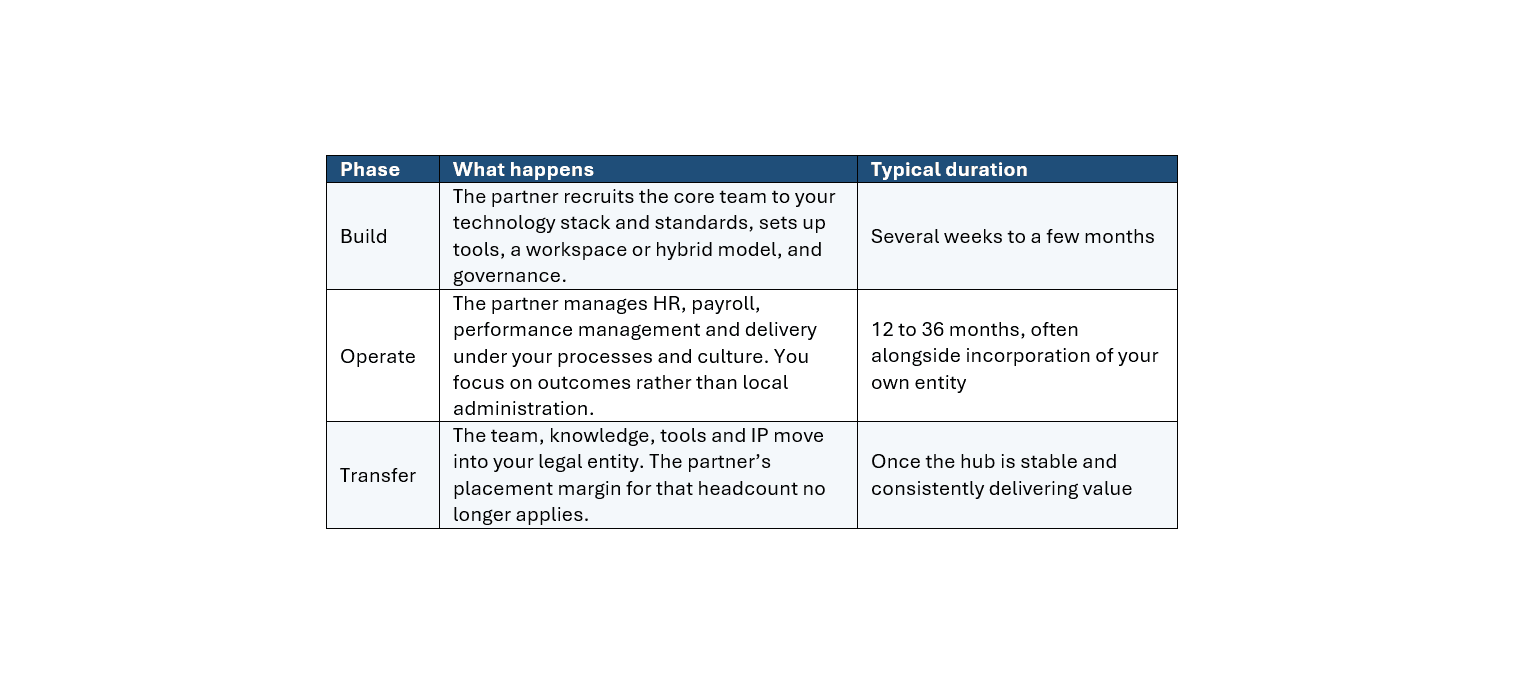
Build-Operate-Transfer is a three-phase partnership in which a local specialist:
- Builds the team by recruiting engineers and setting up the tools, workspace and governance required to meet your standards.
- Operates the team on your behalf for an agreed period, commonly 12 to 36 months, managing payroll, HR, local compliance and day-to-day people operations.
- Transfers the team, its knowledge and relevant assets into your legal entity once the operation is stable and delivering value.
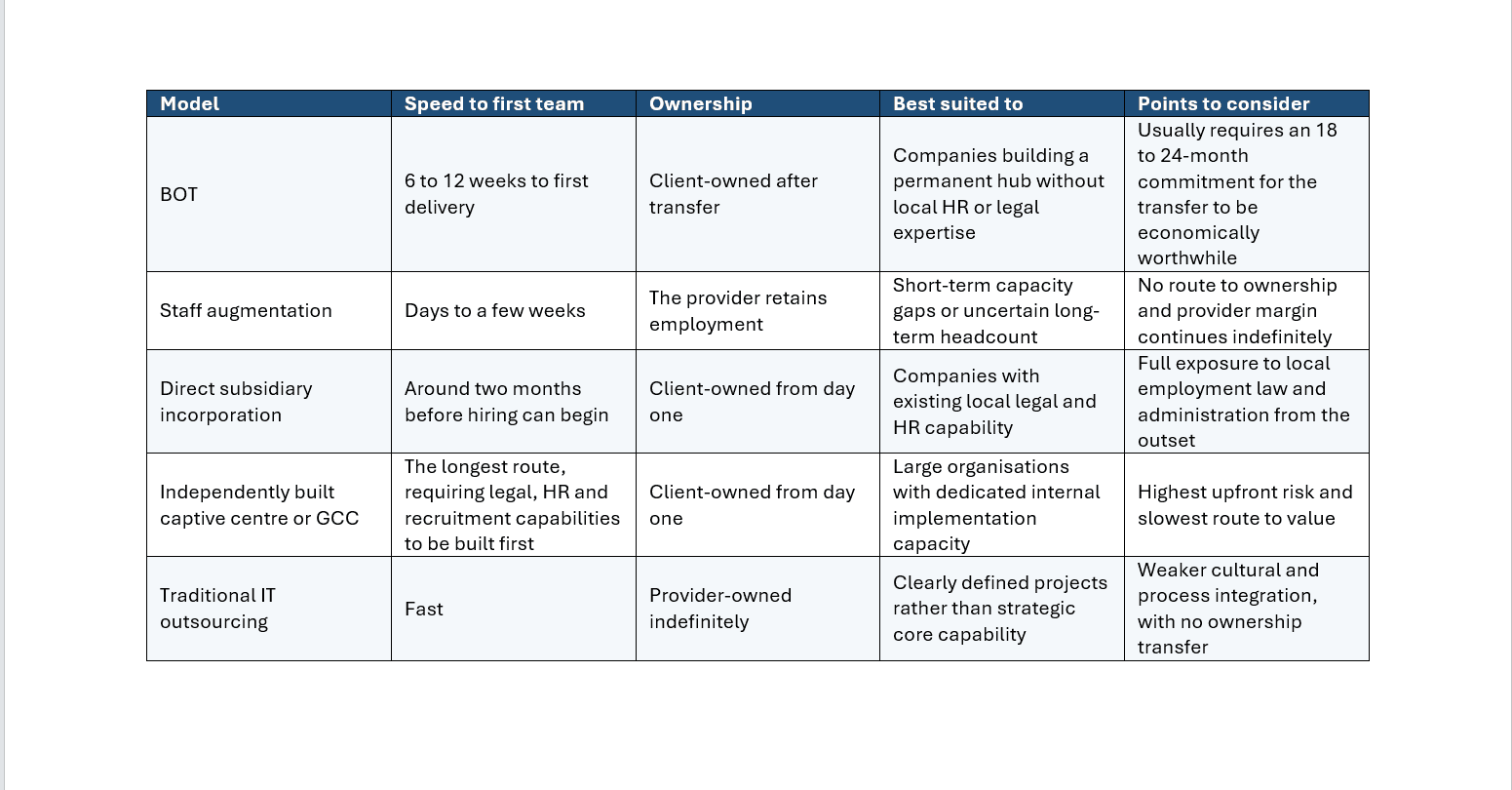
The outcome is a fully owned tech hub with your brand, governance and strategic direction, without the risk of building everything from scratch in an unfamiliar market. In practice, a BOT partner can typically support first delivery within 6 to 12 weeks. By comparison, legal incorporation alone can take around two months in many European countries before direct hiring can begin.
Why this decision is on so many CTOs' desks right now
Three pressures are encouraging IT leaders to consider BOT as a route into Europe:
- Talent shortages in home markets. Many technology companies struggle to find skilled developers locally, which makes nearshore locations with deeper engineering talent pools more attractive.
- Growing interest in hybrid ownership models. BOT combines a partner’s operational support with a clear route to full ownership and control.
- Cost pressure without sacrificing governance. The model can reduce the cost of building senior engineering capacity while avoiding the governance gaps that can arise in purely outsourced arrangements.
This approach addresses four issues that senior decision-makers, including CTOs, CIOs, COOs, VPs of Engineering and IT Directors, regularly face when scaling delivery: tight deadlines, limited internal capacity, cost and return-on-investment scrutiny, scarce specialist talent and integration risk with external teams. BOT is designed to address these challenges together through speed, transparent costs, qualified talent and structured integration into your culture.
When BOT is the right choice and when it isn't
Choose BOT when:
You want a hub that you will eventually own and operate through your own legal entity, but do not yet have local HR, payroll or employment-law expertise.
- You need to move quickly and want a team working within weeks through a local partner rather than after a months-long, from-scratch setup.
- You want to validate the team, market and talent pool before committing to a permanent office or legal entity.
- Your initial need is a core team of around three to five people, often two to three engineers and a project manager, with scope to grow over time.
Consider another option when:
- You already have an established legal entity and HR function in the country. Direct hiring or a subsidiary build-out may then be faster and more cost-effective.
- You need only one or two contractors for a short, well-defined project. Staff augmentation avoids BOT’s longer minimum commitment.
- You do not plan to take on direct employment at any stage. Ongoing outsourcing may be a better fit than a model designed around eventual ownership transfer.
Why Portugal is a strong location for a BOT tech hub
Portugal, and Lisbon in particular, is a common choice for companies using this model in Europe:
- Talent depth. Portugal offers a strong pipeline of software engineers and specialists in DevOps, QA, data and cloud, supported by leading universities and engineering schools and a proven ability to attract international technology talent.
- Time-zone alignment. Lisbon offers real-time overlap with Western and Central Europe, as well as workable collaboration with North America. This matters for agile teams and DevOps handovers.
- Competitive cost structure. Engineering salaries and setup costs remain meaningfully below those in Northern and Western Europe.
- An established ecosystem. Portugal has a mature nearshore and managed services market, with local partners experienced in employment-law compliance and recruitment beyond LinkedIn-visible candidates.
How a BOT engagement works