


Aubay blog

Tech Hub
What Is the Best Way to Establish an R&D Hub in Portugal?
The best route combines three decisions made together, rather than in sequence.
Quick answer
First, enter through a Build-Operate-Transfer model or a comparable local partner so you can hire senior researchers and PhD-level talent in weeks rather than months. Second, structure the team and its output from day one to meet the requirements of Portugal’s R&D incentives, including the SIFIDE II tax credit, the Patent and Software Box regime and the IFICI tax rate for qualifying researchers. Retrofitting eligibility later is much harder than designing for it from the start. Third, locate the hub close to the university ecosystem that matches your research focus: Lisbon for engineering and data science, Porto for hardware and electronics, Braga for semiconductors and Coimbra for life sciences and deep research. When these three choices are aligned, Portugal’s R&D incentive stack can materially outperform a generic tech-hub setup in the same country.
Step 1: choose your route into Portugal
An R&D hub involves the same entry-model decision as any other Portuguese tech hub, but the stakes are higher because researchers with PhDs and senior specialist profiles are scarcer and slower to recruit directly:
- Build-Operate-Transfer. A local partner recruits and operates the research team under your technical direction, then transfers the entity, team and IP fully into your ownership, commonly within 12 to 36 months. It is often the fastest way to have specialist researchers working because the partner manages local employment-law and payroll complexity while you retain technical direction, hiring approval and IP from day one.
- Direct subsidiary incorporation. This gives you full control and full operational responsibility from the outset. You manage Portuguese Labour Code compliance, payroll and recruitment for a highly specialised talent pool, which can take longer to turn into productive headcount.
- A university or Collaborative Laboratory, CoLAB, partnership. This model supports co-funded applied research with a recognised Portuguese research institution. It can accelerate access to deep specialist talent and public co-financing, but generally works best alongside, rather than instead of, your own hub.
Whichever route you choose, register your R&D activity and personnel with the appropriate bodies early. This is what unlocks the incentives in the next step.
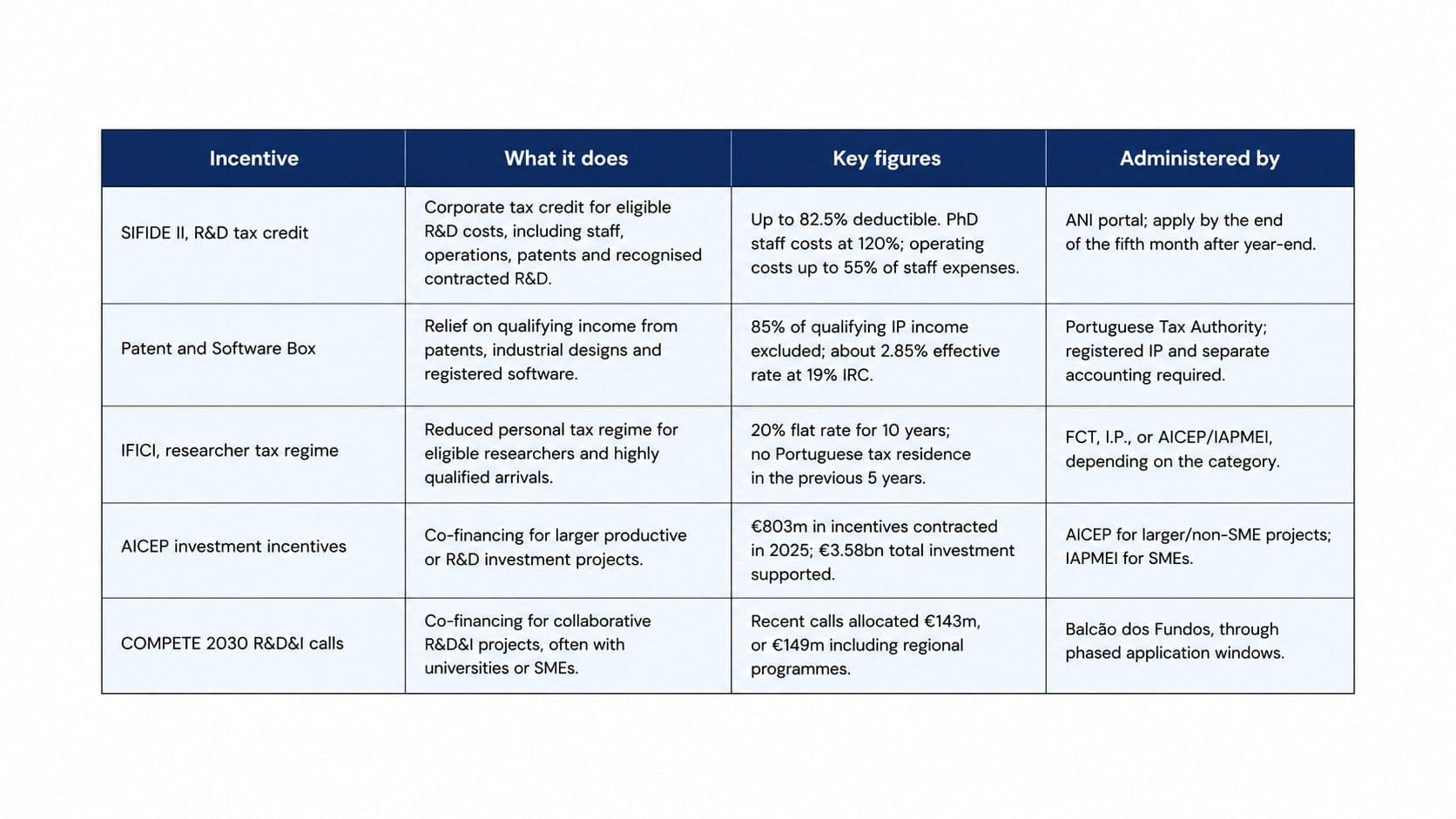
In practical terms, SIFIDE rewards the company’s R&D expenditure and the Patent Box rewards qualifying IP income. IFICI benefits eligible researchers who relocate to Portugal. These incentives can be combined, allowing a well-structured hub to benefit on both the corporate and talent sides. AICEP and COMPETE 2030 grants may also offset part of the initial build cost.
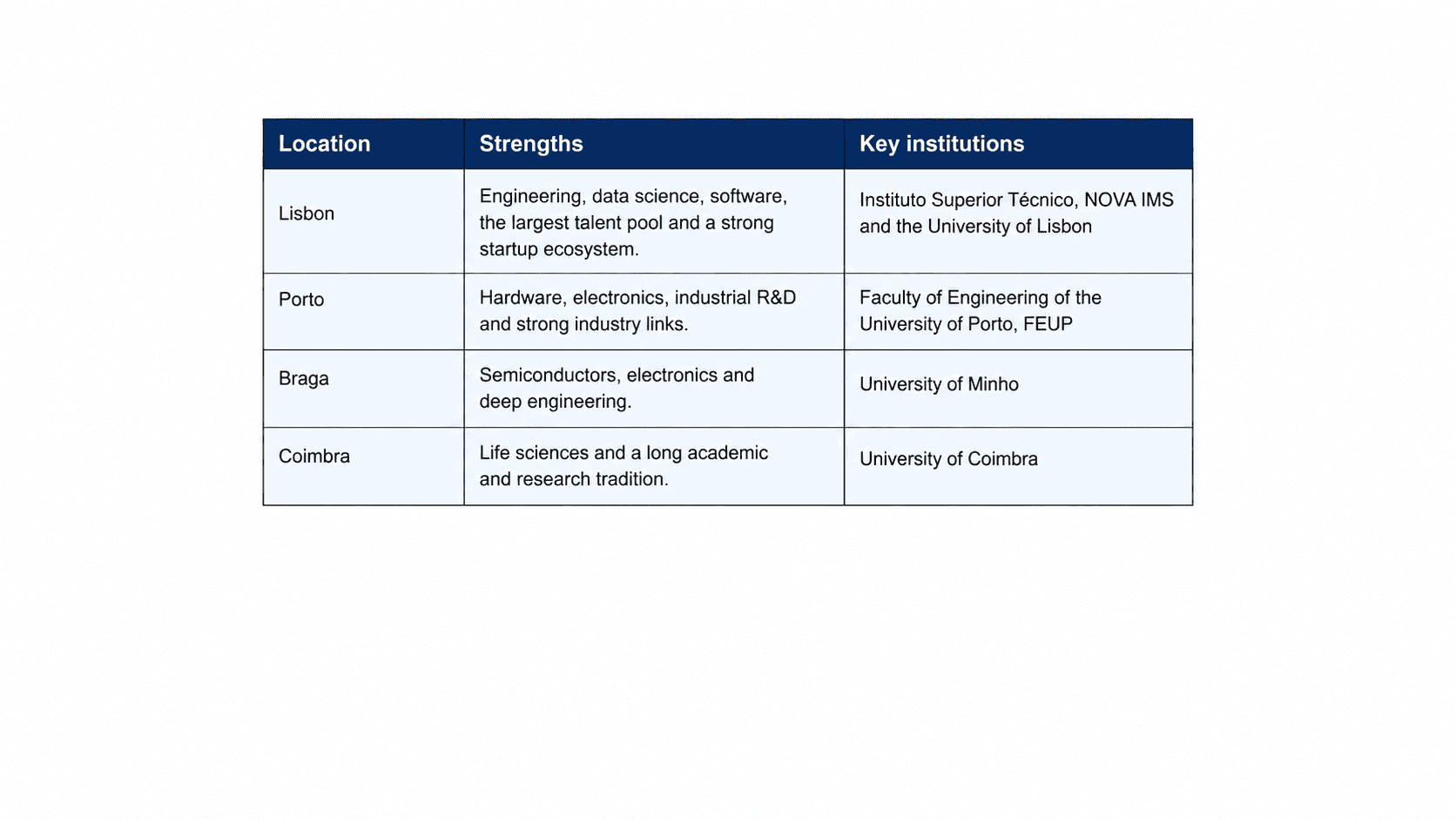
Step 3: select a location that fits your research focus
Step 4: structure the team for eligibility
Eligibility is not automatic. It depends on how the hub is structured and documented:
- Register the entity and R&D personnel with ANI for SIFIDE purposes, and retain documentation on staff qualifications, including PhD status, and R&D project scope from day one.
- Keep IP development in-house rather than outsourcing it or acquiring it from related parties. The Patent Box benefit is reduced when underlying development was not carried out internally.
- When relocating senior researchers, confirm their IFICI eligibility category and registration path before relocation. The five-year non-residency test is assessed individually.
- If you are pursuing AICEP or COMPETE 2030 co-financing, include the funding application in your project plan early. These schemes operate through fixed application windows rather than on-demand approval.
Bringing the plan together
A realistic sequence is to enter through a BOT partner and get a core research team, often three to five people, working within weeks. Register the entity and relevant personnel for SIFIDE and, where applicable, IFICI in parallel. Keep IP development in-house from the first project so later Patent Box eligibility is not compromised. Then consider an AICEP or COMPETE 2030 application once the hub’s scope and headcount plan are sufficiently defined. Aubay Portugal supports this type of engagement for international clients building engineering and R&D capacity in Lisbon, helping teams scale in around 30 days rather than a typical six-month internal hiring cycle, while technical direction and hiring approval remain with the client from the first hire.
Frequently asked questions
Ready to map your R&D hub?
If you are deciding how to structure an R&D hub in Portugal, including the legal model, incentive eligibility and location, Aubay Portugal can discuss what a Build-Operate-Transfer timeline and incentive-ready team structure could look like for your research area and headcount plan.
Categories
All
Aubay Experts
Aubay Portugal
IT
Nearshore
Team Augmentation
Team Extension
Managed Services
Tech Hub
Next post