



Who Can Help You Set Up a European Tech Hub in Portugal Without Giving Up Control?
Creating a tech hub in Portugal does not require giving up control. Learn how the BOT model works, which decisions you retain, and what to assess in a partner.
Quick answer
Where the concern about control comes from
Concerns about losing control usually stem from one of three real but avoidable situations:
- A vague contract. Some providers describe the Operate phase broadly by saying they manage the team without identifying which decisions remain with the client. That ambiguity, rather than BOT itself, creates concern.
- Confusion between BOT and equity-based models. Joint ventures and co-investment structures may require you to give up equity or board influence in exchange for shared risk. BOT is a services contract, not an equity deal. The entity, IP and team are intended to transfer to the client.
- Confusion between an administrative employer and a decision-maker. During the Operate phase, the partner may be the team’s administrative employer for payroll and compliance purposes. This is a legal arrangement, not a sign that the partner directs the team’s work.
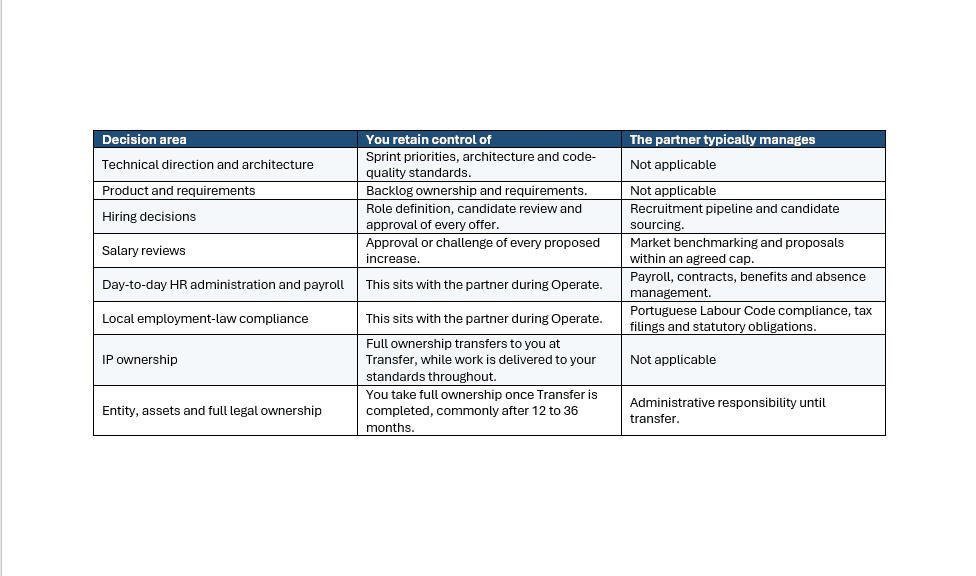
What you control and what the partner manages
Models that do require shared control
If you want to avoid any form of shared decision-making, take particular care with:
- Joint ventures and co-investment structures. You exchange equity or board representation for shared setup risk, giving the local partner a formal role in governance rather than a purely administrative role.
- Revenue-share or as-a-service hub models. Some offers tie a partner’s fees to ongoing performance in ways that give it input on hiring or scope decisions.
- Long-term staff augmentation with no transfer clause. You never own the entity or the team’s employment relationship, so the provider retains long-term leverage over headcount and pricing.
Who can help and what to check before signing
Several Portugal-based and Europe-focused providers offer BOT or BOT-style engagements. Before choosing one, verify:
- A written governance table in the contract that clearly separates client decisions from the partner’s administrative responsibilities.
- A named transfer date or defined transfer trigger, rather than an open-ended Operate phase with no committed handover.
- Hiring and salary approval rights that are explicitly assigned to your company, with clear response-time SLAs, often 48 to 72 hours.
- Clear allocation of responsibility for Portuguese Labour Code compliance to the partner during the Operate phase.
- A track record of completed transfers, not only current Operate-phase clients. Ask for a reference from a company that has gone through Transfer.
Aubay Portugal structures its Lisbon tech-hub engagements in this way. Technical direction, hiring approval and salary approval remain with the client from the first hire, while Aubay manages Portuguese Labour Code compliance, payroll and day-to-day HR administration during the Operate phase. Teams can scale in around 30 days rather than a typical six-month internal hiring cycle, with recruitment costs around 40% lower and consultant retention of 98% through to transfer.